Today businesses are turning to intelligent cloud technology to work smarter and faster. By combining the power of the cloud with computer technology, companies can process huge amounts of data in real time, uncover insights, and automate tasks that used to take hours, especially by leveraging Robotic Process Automation Service - 로봇 프로세스 자동화 서비스, which streamlines repetitive workflows and reduces manual effort.
For teams connecting with customers, AI-driven marketing and smart marketing technology are game-changers. These tools help businesses understand their audiences, deliver personalized campaigns, and even anticipate customer needs before they arise,all without overwhelming their teams.
Meanwhile, AI for financial management is helping organizations make better decisions, manage risks, and spot opportunities for growth more quickly than ever. By using AI to analyze financial trends, businesses can stay ahead of the curve and plan with confidence.
All of these innovations come together in a modern AI call center, creating growth opportunities with an AI call center by combining automation, intelligence, and real-time insights to deliver seamless, personalized customer experiences. With a contact center AI platform, companies can bring together automation, intelligence, and real-time insights to deliver seamless, personalized experiences,while freeing agents to focus on the interactions that matter most.
What Is a Contact Center AI Platform?
A contact center AI platform is a unified software layer that adds artificial intelligence to your customer service operations. It connects to your existing channels and tools to provide capabilities like virtual agents, intelligent routing, real‑time agent assistance, and advanced analytics.
Think of it as thebrainof your contact center: it understands what customers want, decides how best to help, and supports agents with the right information at the right time.
Key Characteristics
- Channel‑agnostic– Works across voice, email, chat, messaging apps, and social media.
- AI‑driven– Uses natural language understanding (NLU), machine learning, and predictive models.
- Agent‑centric– Enhances human agents with guidance, not just automation.
- Data‑first– Captures and analyzes every interaction to reveal patterns and opportunities.
- Integratable– Connects with CRM, ticketing, workforce management, and knowledge systems.
Leading AI Call Center Platforms for Smarter Customer Service
- Bright Pattern
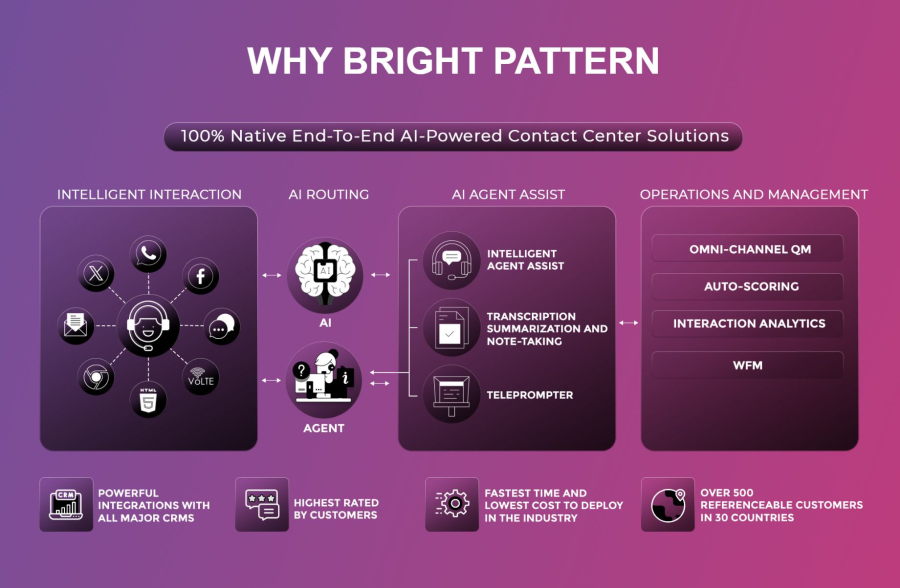
Bright Pattern is a top-rated contact center AI platform that helps businesses deliver seamless, personalized customer experiences across voice, chat, email, SMS, and social media channels. By combining AI-powered automation with advanced workflow management, Bright Pattern enables teams to handle higher interaction volumes without sacrificing service quality. Its features include intelligent routing, real-time analytics, predictive insights, and automation of repetitive tasks, which allow agents to focus on complex customer needs. Businesses using Bright Pattern see improved customer satisfaction, increased agent productivity, and measurable growth opportunities with an AI call center. Its cloud-based platform also scales easily, making it ideal for companies of all sizes looking to modernize their customer service operations.
- Genesys Cloud CX
Offers AI-driven customer engagement across multiple channels, with predictive routing and workforce optimization features.
- Five9
Cloud-based contact center software with AI-powered automation, predictive dialing, and real-time analytics.
- NICE inContact
Combines AI, analytics, and omnichannel routing to streamline customer service and improve agent productivity.
- Talkdesk
An AI-enabled platform that integrates with CRM systems to deliver personalized customer interactions and automation.
- Zendesk
Provides AI-enhanced support workflows, chatbots, and analytics to improve customer service efficiency.
- Amazon Connect
Cloud contact center with AI-powered speech recognition, natural language understanding, and automation.
- Avaya OneCloud
Offers AI-driven contact center solutions with omnichannel support and advanced analytics.
- RingCentral Contact Center
AI-enabled platform with real-time insights, automated workflows, and multi-channel support.
- Cisco Webex Contact Center
Leverages AI to optimize routing, automate tasks, and provide actionable insights across all customer touchpoints.
Key Capabilities of a Modern Contact Center AI Platform
While every platform is different, leading contact center AI solutions tend to offer a similar set of core capabilities. Together, they transform how you serve customers and run operations.
1. Virtual Agents and Intelligent Self‑Service
AI‑powered virtual agents(often called bots or intelligent assistants) handle routine inquiries automatically, 24/7. Unlike basic scripted chatbots, they use natural language understanding to interpret free‑form questions and respond conversationally.
Typical use cases include:
- Account balances, order status, basic troubleshooting.
- Authentication, password resets, and profile changes.
- Simple bookings, cancellations, and reschedules.
- Proactive notifications and reminders.
By resolving common questions through self‑service, you free human agents to focus on complex, high‑value interactions. Customers benefit from instant answers; your team benefits from fewer repetitive tickets.
2. Intelligent Routing and Triage
A contact center AI platform analyzes each interaction in real time to decide where it should go. Instead of routing based solely on menus or simple keywords, it considers multiple signals such as intent, urgency, language, and customer history.
This enables:
- Skill‑based routing– Matching each customer with the best‑qualified agent.
- Priority handling– Surfacing high‑value or high‑risk cases quickly.
- Context‑aware transfers– Passing full context when escalating from bot to agent.
The result is faster resolution, less call bouncing, and fewer frustrated customers repeating themselves.
3. Real‑Time Agent Assist
Rather than leaving agents to search for answers mid‑conversation, AI can surface the right information in the moment.Agent assistfeatures monitor calls or chats (with appropriate security and privacy controls) and provide:
- Suggested responses based on customer questions.
- Relevant knowledge base articles and troubleshooting steps.
- Real‑time guidance on compliance scripts or required disclosures.
- Sentiment and escalation alerts for at‑risk interactions.
This shortens handle times, improves consistency, and helps new agents ramp up faster, all while maintaining a more natural, human conversation.
4. Conversation Analytics and Insights
Every interaction contains valuable signals: what customers want, where they get stuck, and how they feel about your brand. A contact center AI platform uses speech and text analytics to turn unstructured conversations into structured data.
Common capabilities include:
- Topic and intent analysis– Identifying why customers contact you.
- Sentiment and emotion detection– Tracking satisfaction trends over time.
- Root‑cause insights– Pinpointing product, process, or policy issues driving contacts.
- Quality monitoring– Scoring interactions for adherence and performance.
These insights fuel continuous improvement across operations, product design, marketing, and customer experience strategy.
5. Knowledge Management and Content Automation
AI can also support a more dynamic and accurate knowledge ecosystem. Modern platforms help you:
- Centralize FAQs, troubleshooting guides, and policy documents.
- Automatically suggest updates based on trending issues.
- Generate draft responses or help‑center articles from conversation patterns.
- Serve tailored content to different audiences and channels.
The result is a living knowledge base that evolves with your customers, not a static repository that quickly goes out of date.
6. Workforce Optimization and Forecasting
Because a contact center AI platform sees every interaction and outcome, it can support smarter workforce planning. When integrated with workforce management tools, AI can help:
- Forecast contact volumes by channel, topic, and time‑of‑day.
- Recommend staffing levels and shift patterns.
- Identify training needs by analyzing performance and knowledge gaps.
- Highlight opportunities for additional automation.
This leads to more balanced workloads, better service levels, and lower overtime and staffing waste.
Business Benefits: Why Invest in a Contact Center AI Platform?
Organizations adopt contact center AI platforms to achieve concrete, measurable outcomes. While results vary, several benefits show up consistently across industries.
1. Faster Response and Resolution
AI‑driven self‑service, routing, and agent assist combine to reduce wait times and handle times. Customers get answers more quickly, while agents spend less time searching for information or transferring calls.
Speed does not just improve satisfaction; it also frees capacity so your team can handle more volume without sacrificing quality.
2. Higher Customer Satisfaction and Loyalty
When customers can reach you on their channel of choice, receive personalized support, and avoid repeating information, their satisfaction naturally improves. A contact center AI platform supports this by:
- Remembering context across channels and sessions.
- Tailoring responses based on customer history and preferences.
- Ensuring consistent answers, regardless of which agent or bot responds.
Over time, this builds trust and loyalty, reducing churn and increasing lifetime value.
3. Lower Operating Costs
Automation is a major cost driver: by deflecting routine interactions to AI, you reduce the workload handled by human agents. But the savings do not stop there.
Additional cost benefits include:
- More efficient staffing through better forecasts.
- Reduced training time thanks to real‑time guidance.
- Fewer repeat contacts due to more accurate, consistent answers.
The net effect is a more efficient operation that delivers better experiences at a lower cost per contact.
4. Empowered, More Engaged Agents
A well‑designed AI platform does not replace agents; it empowers them. By offloading repetitive tasks and providing in‑the‑moment support, AI allows your team to focus on meaningful, complex work.
This leads to:
- Less burnout from handling the same basic questions repeatedly.
- Higher confidence when dealing with unfamiliar or sensitive issues.
- Clearer coaching opportunities based on interaction analytics.
Happier, better‑equipped agents tend to create happier customers, creating a positive feedback loop for your entire operation.
5. Deeper Customer and Product Insights
Traditional reporting focuses on volumes and handle times. An AI‑driven platform goes further by helping you understand thewhybehind those numbers.
With rich conversation analytics, you can:
- Spot emerging issues early, before they grow into major problems.
- Discover new product features or services customers are asking for.
- Measure sentiment across segments, regions, or campaigns.
These insights help you improve not only the contact center, but also your products, policies, and customer journey as a whole.
Typical Use Cases Across Industries
Contact center AI platforms are flexible by design. Here are some of the most common use cases across sectors.
Retail and E‑commerce
- Order tracking, returns, and exchanges via chat or messaging.
- Automated product recommendations and guided selling.
- Proactive alerts about delivery changes or stock issues.
Financial Services
- Balance inquiries, transaction history, and card controls.
- Secure identity verification before connecting to an agent.
- Fraud alerts and dispute initiation with guided workflows.
Telecommunications and Utilities
- Outage reporting and status updates.
- Plan changes, add‑ons, and bill explanations.
- Technical troubleshooting with guided steps and device recognition.
Travel and Hospitality
- Booking changes, cancellations, and upgrades.
- Check‑in assistance and itinerary information.
- Loyalty program support and personalized offers.
Public Sector and Healthcare
- Information on services, eligibility, and appointment scheduling.
- High‑volume information hotlines for public programs.
- Pre‑visit questionnaires and reminders to reduce no‑shows.
How a Contact Center AI Platform Compares to a Traditional Contact Center Stack
Many organizations already use IVR systems, basic chatbots, and multiple point solutions. A dedicated AI platform adds a layer of intelligence and unification that legacy systems typically lack.
|
Aspect |
Traditional Contact Center |
With Contact Center AI Platform |
|
Automation |
Menu‑based IVR and scripted bots. |
Conversational AI with flexible self‑service and context. |
|
Routing |
Simple rules based on queues or menus. |
Intent, sentiment, and skill‑based routing with history. |
|
Agent Support |
Manual searches and static scripts. |
Real‑time suggestions, knowledge surfacing, and coaching. |
|
Analytics |
Basic metrics and limited call sampling. |
Full conversation analytics across all channels. |
|
Customer Experience |
Channel silos and repeated questions. |
Omnichannel context and personalized journeys. |
Key Features to Look For in a Contact Center AI Platform
When evaluating platforms, focus on capabilities that will drive real outcomes for your business. Consider the following categories.
1. AI Quality and Language Capabilities
- Strong natural language understanding in the languages your customers use.
- Ability to handle accents, noise, and colloquial language for voice.
- Support for both structured flows and open‑ended conversations.
2. Omnichannel Support
- Coverage for all key channels: voice, web chat, mobile apps, messaging, and email.
- Shared context across channels so customers can switch without starting over.
- Unified reporting across channels to track the full customer journey.
3. Integration and Extensibility
- Connectors or APIs to your CRM, ticketing, telephony, and workforce tools.
- Ability to use your existing identity and access management.
- Options for custom logic, workflows, and data models as you scale.
4. Analytics and Reporting
- Out‑of‑the‑box dashboards for volume, performance, and quality.
- Searchable transcripts and conversation intelligence.
- Export options to feed your data warehouse or BI tools.
5. Administration and Ease of Use
- Visual tools to design and manage virtual agent flows.
- Role‑based access control for admins, supervisors, and analysts.
- Clear change management and versioning for content and logic.
6. Security, Privacy, and Compliance
- Strong encryption for data in transit and at rest.
- Granular controls for recordings, transcripts, and retention.
- Support for your regulatory requirements and industry standards.
Practical Steps to Implement a Contact Center AI Platform
Moving to an AI‑powered contact center is most successful when approached in stages. A phased rollout lets you prove value early and build momentum.
Step 1: Define Clear Objectives
Start by identifying what success looks like. Common objectives include:
- Deflecting a portion of routine contacts to self‑service.
- Reducing average handle time for specific interaction types.
- Improving first contact resolution for high‑value customers.
- Gaining better visibility into drivers of contact volume.
Step 2: Prioritize High‑Impact Use Cases
Analyze your contact reasons and volumes, then prioritize a handful of high‑impact, low‑complexity journeys for your first wave. Ideal candidates are:
- Frequent and repetitive, such as status checks or simple changes.
- Well‑documented with existing knowledge content.
- Low‑risk in terms of compliance and customer emotion.
Step 3: Design Experiences for Both Bots and Agents
AI should support the entire journey, not just the self‑service entry point. For each use case, design:
- The ideal conversational flow for the virtual agent.
- Clear rules for when to escalate to a human.
- What context and recommendations to pass to the agent.
This ensures seamless handoffs and a consistent customer experience.
Step 4: Train, Test, and Iterate
Use historical transcripts and test data to teach your AI platform how customers actually speak. Then pilot with a subset of customers or channels.
Monitor:
- Resolution rates for virtual agents.
- Customer feedback and sentiment shifts.
- Impact on agent workloads and performance.
Refine intents, flows, and knowledge content continuously based on real‑world usage.
Step 5: Scale and Expand Use Cases
Once the initial journeys are performing well, expand to more complex scenarios, additional languages, or new channels. Continue to mix automation with human support to maintain a high‑quality experience.
Success Story Patterns: What High‑Performing Teams Do Differently
Organizations that get the most from their contact center AI platform often share a few traits. While every environment is unique, some success patterns are widely applicable.
- Cross‑functional ownership– Customer service, IT, product, and data teams jointly shape the roadmap.
- Continuous optimization– AI models, conversation flows, and knowledge content are regularly reviewed and updated.
- Agent involvement– Frontline agents provide feedback on AI suggestions and highlight gaps.
- Customer‑centric design– Journeys are designed from the customer perspective, not internal processes alone.
By treating the platform as an evolving capability rather than a one‑time project, these teams unlock compounding gains in efficiency and experience.
The Future of Contact Centers with AI
As AI capabilities continue to advance, contact center AI platforms are moving from reactive support engines to proactive, predictive experience platforms. Over time, you can expect:
- More proactive outreach to prevent issues before customers contact you.
- Richer personalization based on real‑time behavior and preferences.
- Tighter alignment between service, sales, and marketing experiences.
- Even more agent augmentation, with AI handling administrative work in the background.
Organizations that invest early and learn how to operate with AI at the center of their contact strategy will be well positioned to differentiate on customer experience.
Conclusion: Turning Your Contact Center into a Strategic Advantage
A contact center AI platform is more than a technology upgrade. It is a new operating model for customer service that blends the strengths of automation and human empathy.
By unifying channels, enriching every interaction with intelligence, and empowering agents with real‑time support, the right platform helps you:
- Delight customers with fast, frictionless support.
- Run a leaner, more efficient operation.
- Unlock powerful insights that shape your broader business strategy.
For organizations ready to transform their contact center from a cost center into a growth engine, an AI platform provides the foundation. The sooner you start, the faster you can build experiences that keep customers coming back.
